
September 2026 Exhibit

Elise Wagner
Finding Buoyancy
September 12 – October 5
We are honored to be presenting a third solo exhibition for Elise Wagner with a new collection of encaustic paintings titled Finding Buoyancy. This series, created from her studio perched out over the mighty Columbia River in Astoria, Oregon has been largely defined by the space and its relation to the river. The exhibition opens during Astoria’s Artwalk, September 12, Wagner will be present at the opening reception that day, 5 – 8 pm. She will also be back on Saturday, September 19th at 2:00 pm to give an artist’s talk about her process, inspiration and career. The exhibition will be on view through October 5th.
An artist’s studio can be a place of solitude, an incubator of ideas, a place of sanctuary to process thoughts into compositions of reflection. For Wagner, her space and physical relationship to the river have provided all those elements, immersing and permeating her compositions, anchored physically by a buoy that is steadfastly tethered in place, marking passage while keeping navigator’s safe. This small man-made structure has become metaphor for Wagner, who’s attention has been captured by what she considers to be a symbol of resilience, orientation, and the ability to remain afloat amid challenging times.
About this series, Wagner states: “From the window of my studio on the Columbia River, I’ve been watching this one buoy along with the movement of water, vessels, sea lions and birds. These floating markers, small, bright points bobbing in the vast river, have become a presence in my work as I seek balance amid the currents of constant change.” After a period of 5 years of self-described upheaval; leaving her established home of 38 years, drastic changes in personal relationships, the loss of family members she has found herself in a state of forced transitions, pivoting from what wasn’t working to what is. This series reflects on that personal and sometimes painful process, her surroundings shaping the content of those changes through deep reflection and recognizing metaphor as a tool. She goes on to say, “Finding Buoyancy grew from living within these opposing forces and from the question of how we remain open to life and keep going when the currents beneath us are in constant motion. Finding Buoyancy explores the tension between weight and weightlessness, surface and depth, movement and stillness. Through encaustic painting and wax collagraph printmaking, I build layered surfaces that reflect shifting currents, geological formations, atmospheric patterns, and the passage of time.”
Encaustic is itself an ancient art form, with origins from the ancient Greeks and Egyptians. And Wagner’s choice of medium is no accident, the alchemy of the process itself lending to her complex sense of the visual language and subject matter, both looking forward while looking back. Through encaustic, her passion for both science and art has become the perfect vehicle to create dialogue and a bridge between cartography use within ancient history to the uncharted galaxies and now the waterways that shape the land. Wagner’s work has evolved over the years, with a strong sense of maturity and confidence present while holding constant to her fascination in uncovering the unseen and her constant exploration of materials.
Wagner is known as a prolific, hands-on kind of artist, never to sit idle with a decades long career that is nothing short of inspiring through her commitment and drive as a fine artist. She is a recipient of a Pollack Krasner Foundation Award as well as receiving grants from the Oregon Arts Commission with work found in both private and corporate collections across the US, Canada, and Mexico. As an educator she has been invited to teach and present encaustic painting and printmaking at conferences and institutions Internationally and currently teaches virtual and private workshops. Currently her work can be seen in art venues from Astoria, Oregon to New York, Seattle to Washington DC.
Elise Wagner
Finding Buoyancy
September 12 – October 5
We are honored to be presenting a third solo exhibition for Elise Wagner with a new collection of encaustic paintings titled Finding Buoyancy. This series, created from her studio perched out over the mighty Columbia River in Astoria, Oregon has been largely defined by the space and its relation to the river. The exhibition opens during Astoria’s Artwalk, September 12, Wagner will be present at the opening reception that day, 5 – 8 pm. She will also be back on Saturday, September 19th at 2:00 pm to give an artist’s talk about her process, inspiration and career. The exhibition will be on view through October 5th.
An artist’s studio can be a place of solitude, an incubator of ideas, a place of sanctuary to process thoughts into compositions of reflection. For Wagner, her space and physical relationship to the river have provided all those elements, immersing and permeating her compositions, anchored physically by a buoy that is steadfastly tethered in place, marking passage while keeping navigator’s safe. This small man-made structure has become metaphor for Wagner, who’s attention has been captured by what she considers to be a symbol of resilience, orientation, and the ability to remain afloat amid challenging times.
About this series, Wagner states: “From the window of my studio on the Columbia River, I’ve been watching this one buoy along with the movement of water, vessels, sea lions and birds. These floating markers, small, bright points bobbing in the vast river, have become a presence in my work as I seek balance amid the currents of constant change.” After a period of 5 years of self-described upheaval; leaving her established home of 38 years, drastic changes in personal relationships, the loss of family members she has found herself in a state of forced transitions, pivoting from what wasn’t working to what is. This series reflects on that personal and sometimes painful process, her surroundings shaping the content of those changes through deep reflection and recognizing metaphor as a tool. She goes on to say, “Finding Buoyancy grew from living within these opposing forces and from the question of how we remain open to life and keep going when the currents beneath us are in constant motion. Finding Buoyancy explores the tension between weight and weightlessness, surface and depth, movement and stillness. Through encaustic painting and wax collagraph printmaking, I build layered surfaces that reflect shifting currents, geological formations, atmospheric patterns, and the passage of time.”
Encaustic is itself an ancient art form, with origins from the ancient Greeks and Egyptians. And Wagner’s choice of medium is no accident, the alchemy of the process itself lending to her complex sense of the visual language and subject matter, both looking forward while looking back. Through encaustic, her passion for both science and art has become the perfect vehicle to create dialogue and a bridge between cartography use within ancient history to the uncharted galaxies and now the waterways that shape the land. Wagner’s work has evolved over the years, with a strong sense of maturity and confidence present while holding constant to her fascination in uncovering the unseen and her constant exploration of materials.
Wagner is known as a prolific, hands-on kind of artist, never to sit idle with a decades long career that is nothing short of inspiring through her commitment and drive as a fine artist. She is a recipient of a Pollack Krasner Foundation Award as well as receiving grants from the Oregon Arts Commission with work found in both private and corporate collections across the US, Canada, and Mexico. As an educator she has been invited to teach and present encaustic painting and printmaking at conferences and institutions Internationally and currently teaches virtual and private workshops. Currently her work can be seen in art venues from Astoria, Oregon to New York, Seattle to Washington DC.
August 2026 Exhibit
Opening Saturday, August 8th, 5 – 8 pm.
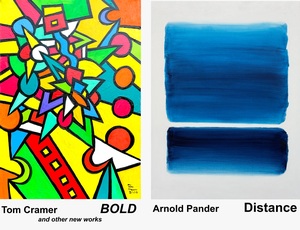
Tom Cramer BOLD & other new works
&
Arnold Pander Distance
Celebrating our 14th anniversary, we are honored to be hosting two solo exhibitions during the month of August. Within our South Gallery we welcome back the inimitable Tom Cramer. He brings his latest series, BOLD, comprised of complex, color saturated oil paintings on canvas and wood burned oil paintings on panel. In our Front Gallery we are excited to host a solo exhibition for Portland visual artist and filmmaker Arnold Pander. For his first show at Imogen, he brings a new series of watercolor paintings as well as oil paintings titled Distance. Both artists have been at the epicenter of the Portland art community for decades, cultivating their own footprint on the visual arts scene while adding to the broader artscape of the city. Stop in to say hello to both Tom and Arnold, Saturday, August 8th 5 – 8 pm. The exhibitions will be on view through September 7th.
Tom Cramer, widely known and respected for his charismatic nature as well as his spontaneous and joyful art has been a dominant force within the Portland art scene for decades, exhibiting his visual art as well as creating public art. He is known to utilize almost anything as his canvas, including buildings, cars, and stage sets. This series, BOLD is a fresh and playful abstract series exuding contagious and uplifting energy.
Within this series Tom’s collectors might note a subtle shift in style as he merges into a new era. His work continues with a strong anchor in use of color and pattern, echoing his long interest in Eastern spirituality, music, and botany. Cramer utilizes organized color, line, and form to suggest geometry, that then in entirety becomes a vessel of essence and/or spirituality.
A conversation with Cramer always leads into avenues that may have been little explored or considered, full of energy, ideas, and many twists. Cramer’s paintings reflect very much the same and are in many ways a direct reference to his own experiences. Drawing inspiration from intense periods of travel and engaging on a deep and personal level in what he considers to be older and wiser cultures, has helped him to create “an art driven by emotional content.” About this series BOLD & other new works, Cramer states: “In this body of work the main goal is emotional content. I am interested in how forms and colors work together to hopefully inspire the viewer. The art is heavily influenced by music - an attempt to attain the poignancy of music, is the desired visual outcome. In a sense, the goal is to turn the viewer on to themselves and for them to achieve a higher state of consciousness.”
It’s with this in mind that Tom is offering his paintings at levels that all can afford. His goal is simple and straight forward; to put art in the hands and hearts of all who will benefit from living with original artwork. Each painting holds spirit and soul, and much like music or poetry it has the profound ability to carry those who engage to a better place whether it be momentary or forever.
Cramer’s formal training began at PNCA in Portland and then on to Pratt Institute in New York. His work has been exhibited at the Tacoma Art Museum and the Portland Art Museum as well as many other prestigious visual art venues. Cramer’s work is also included to the permanent collections of Microsoft, Inc, Portland Art Museum, Jordan Schnitzer Museum of Art, University of Oregon, Boise Art Museum, and many other highly regarded institutions.
In our Front Gallery we are excited to host a solo exhibition for Portland visual artist and filmmaker Arnold Pander. For his first show at Imogen, he brings a new series of watercolor paintings as well as oil paintings titled Distance. Within this series he’s primarily exploring the mystical beauty of light and water through abstracted seascapes, focusing on mood and design.
Arnold Pander, born in the Netherlands and raised in Portland, much like Tom Cramer has enjoyed a multi-faceted career in the arts, spanning decades. Growing up in a family of artists, his father, the highly acclaimed Dutch painter Henk Pander and his mother a master papermaker Marel Kalyn, his world was infused and informed by the creative process from an early age. As a multidisciplinary artist his career has included fine art, comics, film, and cross-media entertainment.
About this collection, Arnold states: “This series of works on paper explores perception and environment at the mouth of the Pacific Ocean, where familiar physical points of reference dissolve into an immeasurable expanse. In this vast landscape, distance becomes imperceptible, and one's sense of place is surrendered to nature's whim, wrath, and wonder.”
Arnold’s paintings appear effortless, yet complete control of medium is clearly established, illustrating the true mark of a confident and experienced painter who is at ease with their chosen medium. Arnold has the ability to coax a desired effect without over doing. Each painting is a reflection on nuance of time, place, and perspective. He goes on to say, “Without a fixed frame of reference, our collective understanding of place gives way to uncertainty, where the images that inhabit these spaces exist as much within the mind's eye as they do in the physical world. Reduced to shape, form, and atmosphere, these landscapes become abstractions—representations of a place that once was, or perhaps never fully existed at all. They invite the viewer to either hold onto a familiar sense of place or allow the work to transform into someplace new, or something else entirely”
His paintings, illustrations, and mixed-media works have been exhibited in galleries and public venues throughout Portland, New York, Los Angeles, San Francisco, and Amsterdam, including Elizabeth Leach Gallery, Mark Woolley Gallery, and Wieden+Kennedy. His editorial and fashion illustrations have appeared in Details and Paper magazines, Warner Bros. Records album packaging, and on television, including an appearance as a fashion illustrator on America's Next Top Model. Most recently, his oil paintings were featured in Season 3 of HBO's Euphoria.
As one half of the Pander Brothers, Arnold earned critical acclaim and an Eisner Award nomination for Grendel: Devil's Legacy. He has written and illustrated projects for major publishers including DC Comics (Batman), Marvel Comics, Dark Horse Comics, and Image Comics. Arnold is also an award-winning filmmaker, producer, and screenwriter. Through Collaborator Studios, he develops original films, graphic novels, and cross-media entertainment properties that unite cinematic storytelling, visual art, and emerging media. Across every discipline, his work explores the evolving relationship between image and narrative.
Opening Saturday, August 8th, 5 – 8 pm.
Tom Cramer BOLD & other new works
&
Arnold Pander Distance
Celebrating our 14th anniversary, we are honored to be hosting two solo exhibitions during the month of August. Within our South Gallery we welcome back the inimitable Tom Cramer. He brings his latest series, BOLD, comprised of complex, color saturated oil paintings on canvas and wood burned oil paintings on panel. In our Front Gallery we are excited to host a solo exhibition for Portland visual artist and filmmaker Arnold Pander. For his first show at Imogen, he brings a new series of watercolor paintings as well as oil paintings titled Distance. Both artists have been at the epicenter of the Portland art community for decades, cultivating their own footprint on the visual arts scene while adding to the broader artscape of the city. Stop in to say hello to both Tom and Arnold, Saturday, August 8th 5 – 8 pm. The exhibitions will be on view through September 7th.
Tom Cramer, widely known and respected for his charismatic nature as well as his spontaneous and joyful art has been a dominant force within the Portland art scene for decades, exhibiting his visual art as well as creating public art. He is known to utilize almost anything as his canvas, including buildings, cars, and stage sets. This series, BOLD is a fresh and playful abstract series exuding contagious and uplifting energy.
Within this series Tom’s collectors might note a subtle shift in style as he merges into a new era. His work continues with a strong anchor in use of color and pattern, echoing his long interest in Eastern spirituality, music, and botany. Cramer utilizes organized color, line, and form to suggest geometry, that then in entirety becomes a vessel of essence and/or spirituality.
A conversation with Cramer always leads into avenues that may have been little explored or considered, full of energy, ideas, and many twists. Cramer’s paintings reflect very much the same and are in many ways a direct reference to his own experiences. Drawing inspiration from intense periods of travel and engaging on a deep and personal level in what he considers to be older and wiser cultures, has helped him to create “an art driven by emotional content.” About this series BOLD & other new works, Cramer states: “In this body of work the main goal is emotional content. I am interested in how forms and colors work together to hopefully inspire the viewer. The art is heavily influenced by music - an attempt to attain the poignancy of music, is the desired visual outcome. In a sense, the goal is to turn the viewer on to themselves and for them to achieve a higher state of consciousness.”
It’s with this in mind that Tom is offering his paintings at levels that all can afford. His goal is simple and straight forward; to put art in the hands and hearts of all who will benefit from living with original artwork. Each painting holds spirit and soul, and much like music or poetry it has the profound ability to carry those who engage to a better place whether it be momentary or forever.
Cramer’s formal training began at PNCA in Portland and then on to Pratt Institute in New York. His work has been exhibited at the Tacoma Art Museum and the Portland Art Museum as well as many other prestigious visual art venues. Cramer’s work is also included to the permanent collections of Microsoft, Inc, Portland Art Museum, Jordan Schnitzer Museum of Art, University of Oregon, Boise Art Museum, and many other highly regarded institutions.
In our Front Gallery we are excited to host a solo exhibition for Portland visual artist and filmmaker Arnold Pander. For his first show at Imogen, he brings a new series of watercolor paintings as well as oil paintings titled Distance. Within this series he’s primarily exploring the mystical beauty of light and water through abstracted seascapes, focusing on mood and design.
Arnold Pander, born in the Netherlands and raised in Portland, much like Tom Cramer has enjoyed a multi-faceted career in the arts, spanning decades. Growing up in a family of artists, his father, the highly acclaimed Dutch painter Henk Pander and his mother a master papermaker Marel Kalyn, his world was infused and informed by the creative process from an early age. As a multidisciplinary artist his career has included fine art, comics, film, and cross-media entertainment.
About this collection, Arnold states: “This series of works on paper explores perception and environment at the mouth of the Pacific Ocean, where familiar physical points of reference dissolve into an immeasurable expanse. In this vast landscape, distance becomes imperceptible, and one's sense of place is surrendered to nature's whim, wrath, and wonder.”
Arnold’s paintings appear effortless, yet complete control of medium is clearly established, illustrating the true mark of a confident and experienced painter who is at ease with their chosen medium. Arnold has the ability to coax a desired effect without over doing. Each painting is a reflection on nuance of time, place, and perspective. He goes on to say, “Without a fixed frame of reference, our collective understanding of place gives way to uncertainty, where the images that inhabit these spaces exist as much within the mind's eye as they do in the physical world. Reduced to shape, form, and atmosphere, these landscapes become abstractions—representations of a place that once was, or perhaps never fully existed at all. They invite the viewer to either hold onto a familiar sense of place or allow the work to transform into someplace new, or something else entirely”
His paintings, illustrations, and mixed-media works have been exhibited in galleries and public venues throughout Portland, New York, Los Angeles, San Francisco, and Amsterdam, including Elizabeth Leach Gallery, Mark Woolley Gallery, and Wieden+Kennedy. His editorial and fashion illustrations have appeared in Details and Paper magazines, Warner Bros. Records album packaging, and on television, including an appearance as a fashion illustrator on America's Next Top Model. Most recently, his oil paintings were featured in Season 3 of HBO's Euphoria.
As one half of the Pander Brothers, Arnold earned critical acclaim and an Eisner Award nomination for Grendel: Devil's Legacy. He has written and illustrated projects for major publishers including DC Comics (Batman), Marvel Comics, Dark Horse Comics, and Image Comics. Arnold is also an award-winning filmmaker, producer, and screenwriter. Through Collaborator Studios, he develops original films, graphic novels, and cross-media entertainment properties that unite cinematic storytelling, visual art, and emerging media. Across every discipline, his work explores the evolving relationship between image and narrative.
July 2026 Exhibit
Matthew Dennison
Mapping Ontology
July 11 – August 3, 2026
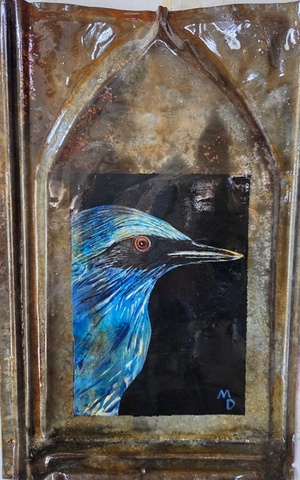
We are excited to host a third solo exhibition for artist Matthew Dennison, and his latest series of paintings titled Mapping Ontology. He brings a new collection of paintings that will include three distinct styles and interests, while incorporating reclaimed materials. Mapping Ontology holds focus on the human figure and will include “Book Cover” paintings, portraits painted to vintage book covers, figurative paintings, painted to 100-year-old door frames and a new series of his narrative paintings, where the stories tell themselves. Stop in to meet Matthew, he’ll be present and available to answer questions about his work during Astoria’s Second Saturday Artwalk, July 11, 5 – 8 pm. The exhibition will be on view through August 3rd.
Matthew Dennison, known for his interest in connection to place and human relations, brings a new series looking deeper into the dynamics of the human role within the world. Ontology itself is by definition the branch of philosophy that investigates the nature of existence, the features all entities have in common, and how they are divided into basic categories of being; in short, the metaphysical dealing with the nature of being. Dennison has long incorporated the human form within his paintings, and this series continues in that vein yet looking deeper into defined roles of individuals while still holding onto ambiguity.
Within this latest series of oil paintings, Dennison continues with a keen sense of youthfulness and a sense of play and/or peril that for many might remind them of times long ago. This sense of nostalgia is consistent throughout the series. With saturated bright and energetic colors, Dennison conveys a sense of freedom yet sometimes an edge of foreboding creeping into content, while still anchored to the moment and untethered to realities of contemporary culture. His distinct style may remind some of illustrations drawing parallels to the mid-century, yet Dennison masterfully takes turns, perhaps teasing the viewer with composition very unlikely attributed to that era. Stylized characters interact with one another in expected ways while surroundings convey a vastly different message.
About this series Dennison states: “I’m interested in placing what I think into painting, by pulling in what triggers my ideas into a visual mapping. My work is a study of the world around me (an ontological dive) and in the end creating a shared personal dialog. I realize that reality is constructed in the mind of the observer. The people in the paintings are people I might not know…or a composite of people I have known. The paintings are a way of casting memories and a visual form of writing.”
Dennison, a long-time contributor to the Northwest’s art community has enjoyed a notable career, exhibiting his work extensively throughout the region as well as Chicago and the east coast. His work is included in the permanent collections of the Portland Art Museum and the Tacoma Art Museum as well as many corporate and private collections around the world.
Matthew Dennison
Mapping Ontology
July 11 – August 3, 2026
We are excited to host a third solo exhibition for artist Matthew Dennison, and his latest series of paintings titled Mapping Ontology. He brings a new collection of paintings that will include three distinct styles and interests, while incorporating reclaimed materials. Mapping Ontology holds focus on the human figure and will include “Book Cover” paintings, portraits painted to vintage book covers, figurative paintings, painted to 100-year-old door frames and a new series of his narrative paintings, where the stories tell themselves. Stop in to meet Matthew, he’ll be present and available to answer questions about his work during Astoria’s Second Saturday Artwalk, July 11, 5 – 8 pm. The exhibition will be on view through August 3rd.
Matthew Dennison, known for his interest in connection to place and human relations, brings a new series looking deeper into the dynamics of the human role within the world. Ontology itself is by definition the branch of philosophy that investigates the nature of existence, the features all entities have in common, and how they are divided into basic categories of being; in short, the metaphysical dealing with the nature of being. Dennison has long incorporated the human form within his paintings, and this series continues in that vein yet looking deeper into defined roles of individuals while still holding onto ambiguity.
Within this latest series of oil paintings, Dennison continues with a keen sense of youthfulness and a sense of play and/or peril that for many might remind them of times long ago. This sense of nostalgia is consistent throughout the series. With saturated bright and energetic colors, Dennison conveys a sense of freedom yet sometimes an edge of foreboding creeping into content, while still anchored to the moment and untethered to realities of contemporary culture. His distinct style may remind some of illustrations drawing parallels to the mid-century, yet Dennison masterfully takes turns, perhaps teasing the viewer with composition very unlikely attributed to that era. Stylized characters interact with one another in expected ways while surroundings convey a vastly different message.
About this series Dennison states: “I’m interested in placing what I think into painting, by pulling in what triggers my ideas into a visual mapping. My work is a study of the world around me (an ontological dive) and in the end creating a shared personal dialog. I realize that reality is constructed in the mind of the observer. The people in the paintings are people I might not know…or a composite of people I have known. The paintings are a way of casting memories and a visual form of writing.”
Dennison, a long-time contributor to the Northwest’s art community has enjoyed a notable career, exhibiting his work extensively throughout the region as well as Chicago and the east coast. His work is included in the permanent collections of the Portland Art Museum and the Tacoma Art Museum as well as many corporate and private collections around the world.
June 2026 Exhibit
Michelle Muldrow
The Roiling Sea
June 13 – July 6
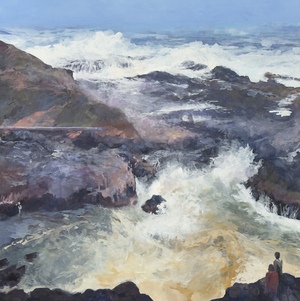
We are excited to welcome back artist Michelle Muldrow and a new series of paintings for her third solo exhibition at Imogen. Her painting is a conceptual exploration of the American landscape, imbued by working history of the land she portrays. The exhibition, The Roiling Sea, opens during Astoria’s Second Saturday Artwalk, June 13th. Muldrow will be in attendance during artwalk and available to answer questions about her work, 5 – 8:00 pm. The exhibition will remain on view through July 6th.
Michelle Muldrow, who is well versed in the arts, is a nationally recognized painter and singer/songwriter. She brings a new collection of paintings exploring the relationships between landscape, consumerism, historical aesthetic philosophy, and personal narrative. Within this series she places the figure within the landscape, to emphasize the role mankind holds in the world. Working in casein on panel with a complex palette, she applies philosophical ideas to American landscape painting, utilizing historical precedents while considering the contemporary experience as bridge, to a greater understanding of America. A continued sense of nostalgia marks her gestural style and sense of composition.
Her chosen medium casein, is itself historical in nature, being one of the original forms of paint, dating back to prehistoric times and utilized in early cave paintings. The medium, soft in tonality with a matte finish lends itself perfectly to her painting style, evoking a dreamlike imprint of memory. Muldrow, driven by personality to explore and understand nuance of both material and composition makes her own casein, commonly known as milk paint. Working with raw pigments, she has total control of the depth of color, achieving saturated and deep hues not usually typical to the medium. She is also calculated in her approach to painting by careful brushstrokes in sheer layers to further build the intensity of applied color.
Reflecting on her past work (her last series shown at Imogen) in juxtapose to where she is now, she states: “Drawn to the late Romanticist era of artists, in conversation with the artists of the past (J.M.W. Turner, James Abbott MacNeil Whistler), my work was reflective of a sense of impending change on the horizon yet honoring the past. It is now two years later, my relationship with the late Romanticist era artists, (late 19th century to the advent of WWI) has melded with contemporary imagery and experience. My methodical discourse with the past, referencing art history, Turner, Whistler and now Winslow Homer, is now insufficient. I have found that I am suddenly incapable of such emotional distance. My aesthetic methodology and painterly techniques have fallen away and all I can do is frantically paint. It is as if I am scrying from tea leaves, each painting a desperate attempt to make sense of what is happening at this point in time. The familiar, the tropes, populist illustrations are all thrown in with spectacle, the distractions, shock and awe, overwhelm and escapism. Everything that was once familiar now asks, is this an omen? What was once normal, now exists only in manipulated fiction. Unable to paint with contemplative distance, I am untethered, every painting is conjured from what I can’t comprehend. Asking, what is next in this roiling sea of change.”
Muldrow has exhibited her work extensively throughout the country, from New York to Los Angeles with many stops in between. She is a 2021 recipient of a Provincetown Art Museum/Lillian Orlowsky and William Freed Grant as well as most recently receiving an Individual Fellowship grant from the Oregon Arts Commission. She has had her work included to many private and corporate collections, including the Microsoft Corporate Art Collection, the Cleveland Clinic Art Collection, Gerard Louis-Dreyfus Art Collection, and many others.
Michelle Muldrow
The Roiling Sea
June 13 – July 6
We are excited to welcome back artist Michelle Muldrow and a new series of paintings for her third solo exhibition at Imogen. Her painting is a conceptual exploration of the American landscape, imbued by working history of the land she portrays. The exhibition, The Roiling Sea, opens during Astoria’s Second Saturday Artwalk, June 13th. Muldrow will be in attendance during artwalk and available to answer questions about her work, 5 – 8:00 pm. The exhibition will remain on view through July 6th.
Michelle Muldrow, who is well versed in the arts, is a nationally recognized painter and singer/songwriter. She brings a new collection of paintings exploring the relationships between landscape, consumerism, historical aesthetic philosophy, and personal narrative. Within this series she places the figure within the landscape, to emphasize the role mankind holds in the world. Working in casein on panel with a complex palette, she applies philosophical ideas to American landscape painting, utilizing historical precedents while considering the contemporary experience as bridge, to a greater understanding of America. A continued sense of nostalgia marks her gestural style and sense of composition.
Her chosen medium casein, is itself historical in nature, being one of the original forms of paint, dating back to prehistoric times and utilized in early cave paintings. The medium, soft in tonality with a matte finish lends itself perfectly to her painting style, evoking a dreamlike imprint of memory. Muldrow, driven by personality to explore and understand nuance of both material and composition makes her own casein, commonly known as milk paint. Working with raw pigments, she has total control of the depth of color, achieving saturated and deep hues not usually typical to the medium. She is also calculated in her approach to painting by careful brushstrokes in sheer layers to further build the intensity of applied color.
Reflecting on her past work (her last series shown at Imogen) in juxtapose to where she is now, she states: “Drawn to the late Romanticist era of artists, in conversation with the artists of the past (J.M.W. Turner, James Abbott MacNeil Whistler), my work was reflective of a sense of impending change on the horizon yet honoring the past. It is now two years later, my relationship with the late Romanticist era artists, (late 19th century to the advent of WWI) has melded with contemporary imagery and experience. My methodical discourse with the past, referencing art history, Turner, Whistler and now Winslow Homer, is now insufficient. I have found that I am suddenly incapable of such emotional distance. My aesthetic methodology and painterly techniques have fallen away and all I can do is frantically paint. It is as if I am scrying from tea leaves, each painting a desperate attempt to make sense of what is happening at this point in time. The familiar, the tropes, populist illustrations are all thrown in with spectacle, the distractions, shock and awe, overwhelm and escapism. Everything that was once familiar now asks, is this an omen? What was once normal, now exists only in manipulated fiction. Unable to paint with contemplative distance, I am untethered, every painting is conjured from what I can’t comprehend. Asking, what is next in this roiling sea of change.”
Muldrow has exhibited her work extensively throughout the country, from New York to Los Angeles with many stops in between. She is a 2021 recipient of a Provincetown Art Museum/Lillian Orlowsky and William Freed Grant as well as most recently receiving an Individual Fellowship grant from the Oregon Arts Commission. She has had her work included to many private and corporate collections, including the Microsoft Corporate Art Collection, the Cleveland Clinic Art Collection, Gerard Louis-Dreyfus Art Collection, and many others.
May 2026 Exhibit
Jo Hamilton
Groundswell
May 9 – June 8
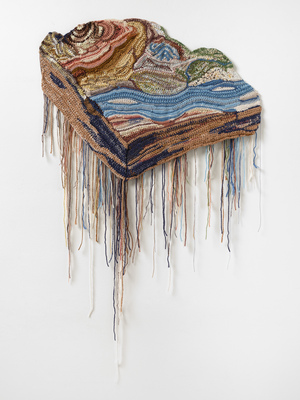
We are honored to be presenting a solo exhibition for the renowned Jo Hamilton and her newest series, Groundswell, during the month of May. Hamilton has enjoyed a remarkable career that has taken her far with her textile-based paintings in yarn. Growing up in Scotland within a family of crocheters and knitters, she learned the skill component of her art making early in life. She now creates large scale fantastical wall hung compositions in yarn from her studio in Portland where she resides. The exhibition opens during Astoria’s Artwalk, May 9th. All are invited to come meet Jo from 5 – 8 pm, Saturday, May 9th who will be available to answer questions about her work. The exhibition will remain on display through June 8th.
This latest series, Groundswell explores real and imaginary interactions between the forces of nature and manmade environments and activities. The term groundswell by definition refers to a sudden gathering of force in public opinion, a violent ocean swelling caused by a distant earthquake or storm, for Hamilton this concept is indicative of the past year. She works from that idea to create elaborate depictions, sometimes dwellings teetering on precarious edge, a submerged church, colonized by coral, a cross section of landscape revealing the fossilized layers of previous era, magma seething a few miles below the earth’s crust, utilizing metaphor within composition to ultimately illustrate the turbulent place mankind is in. She does this with careful consideration to beauty and sometimes a hint of wryness.
About this series she states, “Despite the helplessness we might feel in the face of such seemingly powerful phenomena, the reality of the earth’s resilience and longevity relative to our human consciousness and short span of existence can be both inspiring and comforting. Beneath the surface, under the thin crust on which everything lives, incremental changes and movements are occurring that can eventually bring about monumental, mountainous results. Wind, water and earthquakes are constantly reshaping landscapes and cities.”
Her process is not typical as she works with neither paint nor brush, rather utilizing post-consumer materials through concise decision and concern for the natural environment. After graduating from the Glasgow School of Art in the 1990’s, Hamilton moved to Portland where she integrated her years of training in drawing and painting with the handcraft she learned primarily from her “Gran” during her childhood. About her process she states “My work weaves together these distinct languages, referencing the hand-labor of generations of women as well as contemporary culture. The process involves knotting (and unraveling) hundreds of yarns to create each work. Each knot can represent a moment in time or disappear into he whole, and this interplay between material and subject animates the work.” Hamilton refers to her creations as a “net, filtering and transforming traditionally dominant gender roles and fine art genres.”
Her remarkable “paintings” have gained the attention of collectors and curators around the world with the inclusion of her pieces in the permanent collections of the Portland Art Museum and the Jordan Schnitzer Museum of Art as well as many other private and corporate collections.
Jo Hamilton
Groundswell
May 9 – June 8
We are honored to be presenting a solo exhibition for the renowned Jo Hamilton and her newest series, Groundswell, during the month of May. Hamilton has enjoyed a remarkable career that has taken her far with her textile-based paintings in yarn. Growing up in Scotland within a family of crocheters and knitters, she learned the skill component of her art making early in life. She now creates large scale fantastical wall hung compositions in yarn from her studio in Portland where she resides. The exhibition opens during Astoria’s Artwalk, May 9th. All are invited to come meet Jo from 5 – 8 pm, Saturday, May 9th who will be available to answer questions about her work. The exhibition will remain on display through June 8th.
This latest series, Groundswell explores real and imaginary interactions between the forces of nature and manmade environments and activities. The term groundswell by definition refers to a sudden gathering of force in public opinion, a violent ocean swelling caused by a distant earthquake or storm, for Hamilton this concept is indicative of the past year. She works from that idea to create elaborate depictions, sometimes dwellings teetering on precarious edge, a submerged church, colonized by coral, a cross section of landscape revealing the fossilized layers of previous era, magma seething a few miles below the earth’s crust, utilizing metaphor within composition to ultimately illustrate the turbulent place mankind is in. She does this with careful consideration to beauty and sometimes a hint of wryness.
About this series she states, “Despite the helplessness we might feel in the face of such seemingly powerful phenomena, the reality of the earth’s resilience and longevity relative to our human consciousness and short span of existence can be both inspiring and comforting. Beneath the surface, under the thin crust on which everything lives, incremental changes and movements are occurring that can eventually bring about monumental, mountainous results. Wind, water and earthquakes are constantly reshaping landscapes and cities.”
Her process is not typical as she works with neither paint nor brush, rather utilizing post-consumer materials through concise decision and concern for the natural environment. After graduating from the Glasgow School of Art in the 1990’s, Hamilton moved to Portland where she integrated her years of training in drawing and painting with the handcraft she learned primarily from her “Gran” during her childhood. About her process she states “My work weaves together these distinct languages, referencing the hand-labor of generations of women as well as contemporary culture. The process involves knotting (and unraveling) hundreds of yarns to create each work. Each knot can represent a moment in time or disappear into he whole, and this interplay between material and subject animates the work.” Hamilton refers to her creations as a “net, filtering and transforming traditionally dominant gender roles and fine art genres.”
Her remarkable “paintings” have gained the attention of collectors and curators around the world with the inclusion of her pieces in the permanent collections of the Portland Art Museum and the Jordan Schnitzer Museum of Art as well as many other private and corporate collections.
April 2026 Exhibit
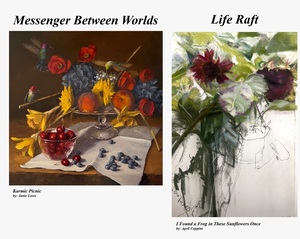
LifeRaft – By April Coppini
&
Messengers Between Worlds – By Janie Lowe
April 11 – May 4
We are excited to be hosting two solo exhibitions at Imogen during April. In our South Gallery we are pleased to share the latest collection of dramatic charcoal (and some with the inclusion of pastel) drawings by April Coppini, titled LifeRaft. Within our front gallery space, we are pleased to be presenting the first solo exhibition at Imogen for the talented oil painter Janie Lowe. Janie offers a new series of elegant paintings titled Messengers Between Worlds. The exhibitions open during Astoria’s artwalk, Saturday, April 11th and both artists will be available to answer questions about their work 5 – 8 pm. The exhibitions will remain on view through May 4th.
April Coppini is widely known for her passionate interest in all creatures and their importance to place, she brings a new collection of gorgeously rendered drawings. Through elegant and expressive mark making she portrays the wild, unseen, and unexpected in her depictions of flora and fauna. Within this series she shares what she looks for inspiration within the awakening of spring and the subtle gifts it brings. LifeRaft, a new series of works on paper, pays homage to the small things around her that offer refuge from the uncertainties of life. This exhibition is about the things that lift us all and keep us afloat through difficult times. Her gestural and painterly approach to mark making sets her apart, creating composition from movement through portrayal of the things that keep her balanced, her internal keel always strong through whatever storm blows over, safe within her own life raft.
In challenging times, whether it’s from a personal perspective or a broader global reach, there is one thing that does remain certain; art is a necessity in our lives, yesterday, today, and tomorrow. Regardless of all, including what their own lives contain, artists always continue to paint, sculpt, write, and perform to communicate, providing a gift of reprieve to all. Artists have always been generous in what they do, whether it is to connect what is good about humanity or record an imprint of challenging times. They create and share, with the goal of easing burden, fear, and struggle; to uplift and bring peace to the unknown and even aiding in the comprehension of matters out of one’s control. It is with this in mind that Coppini has created another exceptional body of work, with the hopes of easing burden and looking to the marvelous to uplift and hold.
Within this series she continues to portray a focused record in her subject matter, the simple struggle of existence. A slight tension of muscle before a possible leap, or the look of pensive awareness in preparation for escape from a possible predator, are all elegantly conveyed through beautiful and gestural mark making. With the underlying message of the importance of all creatures and their independent role to ecosystem and/or as pollinators, predators, scavengers or even domesticated animals, Coppini asks the viewer to consider the role our species takes (or doesn’t) in protecting the delicate relationship between mankind and animal as well as a direct reminder of our symbiotic relationship to all life on a global level. There is also the underlying reminder of appreciating what is good, those moments that take us away from the stress of day to day life, in turn providing a sense of strength and resilience.
Still relying on the starkness of charcoal line to develop the foundation of her drawings, she softens her compositions with the introduction of vibrant and rich color that provide more than a visual response. She looks for balance within each piece, both from a compositional source as well as nuance of content to honor simple beauty, elegance, and sense of hope. She will also be including several of her rare multimedia paintings in this exhibition.
About this series Coppini states: “I, like maybe most people, have been almost consumed by recent terrible and shocking news and realities. But if I step away from all that noise (which I am lucky to be able to do) and go outside for a moment and am quiet, listen and watch, I can pull myself up and see how to keep going. I can see everything that keeps going around us, regardless. That’s the life raft. I don’t draw to show that I have everything figured out, I draw to try to figure things out. I draw to really look- and be humbled because I’ll never fully get it. I draw things that bring me back to a place of wonder, of not knowing how the story ends- but feeling all the possibilities! That’s the life raft too.”
Within our front gallery space, we are presenting the first solo exhibition at Imogen for the talented oil painter Janie Lowe. Janie offers a new series of elegant paintings titled Messengers Between Worlds. Painting from a classical still life approach, she brings rich and luminescent color depicting hummingbirds as metaphor of connection to afterlife, honoring the things that provide peace and comfort in times of loss. She approaches that sense of loss with beauty and tenderness by portraying the continued vibration of life itself through one of the most delicate of creatures, always imbedded in composition, brimming with the fruits of life.
Janie Lowe has long been inspired by the beauty and resilience of hummingbirds, learning years ago that in many Latin cultures this spectacular yet tiny bird symbolizes strength, hope and migration. It is also believed within certain traditions, the hummingbird has the ability to move between worlds — a messenger between the living and the dead. It was this idea that inspired Lowe to create detailed still life compositions, depicting the essence of spirit through the slight winged beings.
When discussing her inspiration for this series she states: “When I began exploring this idea, stories emerged. Friends shared moments that felt too precise to dismiss as coincidence: unexpected encounters, small and luminous. One friend, grieving the loss of her father, described a hummingbird flying directly toward her, hovering at eye level, holding her gaze. In that suspended moment, she felt unmistakably comforted, as if a message had arrived — that she was not alone, that everything would be okay. These stories lingered with me. They offered a gentler language for grief that was not heavy, but tender- fleeting signs that carry immense meaning. For many, such moments become a source of strength and inspiration, a way of moving through sorrow while remaining open to wonder.”
It was this belief that led Janie to paint hummingbirds. Within this series they are the means of connection, placed alongside her own family’s heirlooms, which hold memory. These intimate vignettes function as small moments caught and held briefly, without the interference of time. For Janie, these memories are what keep a loved one’s spirit alive, a form of continuation. She states, “hummingbirds embody that connection – fleeting yet powerful, delicate yet resilient. They remind me of presence, joy and the enduring threads that link us to those who came before us. And in that reminder, I find both delight and comfort.”
Janie Lowe received her BFA from Texas Tech University and her MFA from the School of Visual Arts in New York City. She illustrated for publications such as The New York Times, Random House Books and a book, The Great Ridley Rescue, written by Pamela Phillips. After a few years of freelance illustrating in New York, he moved to Portland, Oregon to live between the mountains and the coast.
LifeRaft – By April Coppini
&
Messengers Between Worlds – By Janie Lowe
April 11 – May 4
We are excited to be hosting two solo exhibitions at Imogen during April. In our South Gallery we are pleased to share the latest collection of dramatic charcoal (and some with the inclusion of pastel) drawings by April Coppini, titled LifeRaft. Within our front gallery space, we are pleased to be presenting the first solo exhibition at Imogen for the talented oil painter Janie Lowe. Janie offers a new series of elegant paintings titled Messengers Between Worlds. The exhibitions open during Astoria’s artwalk, Saturday, April 11th and both artists will be available to answer questions about their work 5 – 8 pm. The exhibitions will remain on view through May 4th.
April Coppini is widely known for her passionate interest in all creatures and their importance to place, she brings a new collection of gorgeously rendered drawings. Through elegant and expressive mark making she portrays the wild, unseen, and unexpected in her depictions of flora and fauna. Within this series she shares what she looks for inspiration within the awakening of spring and the subtle gifts it brings. LifeRaft, a new series of works on paper, pays homage to the small things around her that offer refuge from the uncertainties of life. This exhibition is about the things that lift us all and keep us afloat through difficult times. Her gestural and painterly approach to mark making sets her apart, creating composition from movement through portrayal of the things that keep her balanced, her internal keel always strong through whatever storm blows over, safe within her own life raft.
In challenging times, whether it’s from a personal perspective or a broader global reach, there is one thing that does remain certain; art is a necessity in our lives, yesterday, today, and tomorrow. Regardless of all, including what their own lives contain, artists always continue to paint, sculpt, write, and perform to communicate, providing a gift of reprieve to all. Artists have always been generous in what they do, whether it is to connect what is good about humanity or record an imprint of challenging times. They create and share, with the goal of easing burden, fear, and struggle; to uplift and bring peace to the unknown and even aiding in the comprehension of matters out of one’s control. It is with this in mind that Coppini has created another exceptional body of work, with the hopes of easing burden and looking to the marvelous to uplift and hold.
Within this series she continues to portray a focused record in her subject matter, the simple struggle of existence. A slight tension of muscle before a possible leap, or the look of pensive awareness in preparation for escape from a possible predator, are all elegantly conveyed through beautiful and gestural mark making. With the underlying message of the importance of all creatures and their independent role to ecosystem and/or as pollinators, predators, scavengers or even domesticated animals, Coppini asks the viewer to consider the role our species takes (or doesn’t) in protecting the delicate relationship between mankind and animal as well as a direct reminder of our symbiotic relationship to all life on a global level. There is also the underlying reminder of appreciating what is good, those moments that take us away from the stress of day to day life, in turn providing a sense of strength and resilience.
Still relying on the starkness of charcoal line to develop the foundation of her drawings, she softens her compositions with the introduction of vibrant and rich color that provide more than a visual response. She looks for balance within each piece, both from a compositional source as well as nuance of content to honor simple beauty, elegance, and sense of hope. She will also be including several of her rare multimedia paintings in this exhibition.
About this series Coppini states: “I, like maybe most people, have been almost consumed by recent terrible and shocking news and realities. But if I step away from all that noise (which I am lucky to be able to do) and go outside for a moment and am quiet, listen and watch, I can pull myself up and see how to keep going. I can see everything that keeps going around us, regardless. That’s the life raft. I don’t draw to show that I have everything figured out, I draw to try to figure things out. I draw to really look- and be humbled because I’ll never fully get it. I draw things that bring me back to a place of wonder, of not knowing how the story ends- but feeling all the possibilities! That’s the life raft too.”
Within our front gallery space, we are presenting the first solo exhibition at Imogen for the talented oil painter Janie Lowe. Janie offers a new series of elegant paintings titled Messengers Between Worlds. Painting from a classical still life approach, she brings rich and luminescent color depicting hummingbirds as metaphor of connection to afterlife, honoring the things that provide peace and comfort in times of loss. She approaches that sense of loss with beauty and tenderness by portraying the continued vibration of life itself through one of the most delicate of creatures, always imbedded in composition, brimming with the fruits of life.
Janie Lowe has long been inspired by the beauty and resilience of hummingbirds, learning years ago that in many Latin cultures this spectacular yet tiny bird symbolizes strength, hope and migration. It is also believed within certain traditions, the hummingbird has the ability to move between worlds — a messenger between the living and the dead. It was this idea that inspired Lowe to create detailed still life compositions, depicting the essence of spirit through the slight winged beings.
When discussing her inspiration for this series she states: “When I began exploring this idea, stories emerged. Friends shared moments that felt too precise to dismiss as coincidence: unexpected encounters, small and luminous. One friend, grieving the loss of her father, described a hummingbird flying directly toward her, hovering at eye level, holding her gaze. In that suspended moment, she felt unmistakably comforted, as if a message had arrived — that she was not alone, that everything would be okay. These stories lingered with me. They offered a gentler language for grief that was not heavy, but tender- fleeting signs that carry immense meaning. For many, such moments become a source of strength and inspiration, a way of moving through sorrow while remaining open to wonder.”
It was this belief that led Janie to paint hummingbirds. Within this series they are the means of connection, placed alongside her own family’s heirlooms, which hold memory. These intimate vignettes function as small moments caught and held briefly, without the interference of time. For Janie, these memories are what keep a loved one’s spirit alive, a form of continuation. She states, “hummingbirds embody that connection – fleeting yet powerful, delicate yet resilient. They remind me of presence, joy and the enduring threads that link us to those who came before us. And in that reminder, I find both delight and comfort.”
Janie Lowe received her BFA from Texas Tech University and her MFA from the School of Visual Arts in New York City. She illustrated for publications such as The New York Times, Random House Books and a book, The Great Ridley Rescue, written by Pamela Phillips. After a few years of freelance illustrating in New York, he moved to Portland, Oregon to live between the mountains and the coast.
March 2026 Exhibit

Forged, Found and Cast
A group exhibition exploring metal as medium
March 14 – April 6
We are excited to host our first ever group exhibition focusing on the use of metal as medium. Included to this unique show will be the work of four local artists who all share a love of metal. Jacob Moore, Rick Crawford, Jeremy Furnish and Mark Oberzil, each bring various examples of technique in metal working as well as strong consideration of composition. Forged, Found & Cast opens during Astoria’s Artwalk Saturday, March 14th with the artists in attendance 5 – 8 pm. The exhibition will remain on view through April 6th.
Jacob Moore, who resides just across the river in Chinook, WA is known for his metal working skills typically applied to jewelry. Having once worked in the oyster farming industry his work has long been inspired by the beautiful and unique forms of the oyster shell. For this exhibition he brings large scale, wall hung oyster shell sculpture created from stainless steel. Also on hand will be his exquisite hand forged oyster shell jewelry pieces. About his inspiration he states, “There is incredible range in the forms that the Giant Pacific Oyster can take as it grows. Time spent culturing the growth of millions of oysters showed me the endless variety in shell forms and inspired these works. Each layer of the shell is built upon the previous layer, perhaps taking a new direction while following a subtle pattern. I build these oyster forms with the same process. The first, smallest, and oldest layer first, then the rest follow. The stainless steel rods are bent by hand while cold, allowing for perfect imperfections in the developing patterns. I start the process with a very general idea of the form the piece will take and ultimately they develop into something unique and different than I imagined.”
Sculptor Rick Crawford of Astoria and known for his work with reclaimed old growth Douglas Fir, brings form-folded copper sculpture. About his process he states, “Non-ferous metals, such as copper, can be shaped/worked while cold, but must be soft to prevent unwanted cracking (unless desired as a design element). Annealing using a torch will render the metal soft for working, until work-hardening sets in... then anneal again until forming complete.” Rick has been creating sculpture and jewelry in both metal and wood for decades and is an active member of the PNW Sculptors organization.
Jeremy Furnish, also of Astoria, creates sculpture of mostly found steel objects, usually bringing a bit of wit and whimsy. He’s known for large scale fabricated installation work, including the occasional combination of glass and steel. A lifelong artist at heart, he was awarded the Coastal Oregon Artist Residency (COAR) through the partnership of Astoria Visual Arts and Recology Western Oregon in 2019, giving him the opportunity to delve deeper in the world of reclaimed materials in art making and place focus on turning what’s been discarded into art. Around that same time he was also awarded a commission to create a commemorative sculpture for the marking of the 125th Annual Astoria Regatta, which is now in its permanent location near the Columbia Maritime Museum.
Mark Oberzil, who splits his time between Astoria and Forest Grove is widely known for his unique and well-executed sculptural jewelry. Also, a lifelong artist, with over 6 decades of experience creating one-of-a-kind. His creative process is as varied as his composition, bringing cast and mixed metal fusing techniques, with the calculated addition of gemstones to provide a hint of color and transparency. When asked about his work he succinctly stated, “Jewelry is the sculpture of personal philosophy.” He then added, “Progress and perfection are inverse variants. Lately, I’ve been thinking about the subject-object relationship of creating anything. I used to work in a linear fashion, starting with an idea or narrative, then a plan, and then creating an object that agreed, more or less, with the original idea. I tended to judge success by how much the result resembled the original idea. Over the years it’s become clear, however, that objects take on a life of their own at some point in the process. (magic workshop alert) The object starts to suggest its own modifications and completion. Naturally, the narrative also changes. Sometimes the piece may be finished without a narrative and so it sits waiting for its story to arrive.”
Forged, Found and Cast
A group exhibition exploring metal as medium
March 14 – April 6
We are excited to host our first ever group exhibition focusing on the use of metal as medium. Included to this unique show will be the work of four local artists who all share a love of metal. Jacob Moore, Rick Crawford, Jeremy Furnish and Mark Oberzil, each bring various examples of technique in metal working as well as strong consideration of composition. Forged, Found & Cast opens during Astoria’s Artwalk Saturday, March 14th with the artists in attendance 5 – 8 pm. The exhibition will remain on view through April 6th.
Jacob Moore, who resides just across the river in Chinook, WA is known for his metal working skills typically applied to jewelry. Having once worked in the oyster farming industry his work has long been inspired by the beautiful and unique forms of the oyster shell. For this exhibition he brings large scale, wall hung oyster shell sculpture created from stainless steel. Also on hand will be his exquisite hand forged oyster shell jewelry pieces. About his inspiration he states, “There is incredible range in the forms that the Giant Pacific Oyster can take as it grows. Time spent culturing the growth of millions of oysters showed me the endless variety in shell forms and inspired these works. Each layer of the shell is built upon the previous layer, perhaps taking a new direction while following a subtle pattern. I build these oyster forms with the same process. The first, smallest, and oldest layer first, then the rest follow. The stainless steel rods are bent by hand while cold, allowing for perfect imperfections in the developing patterns. I start the process with a very general idea of the form the piece will take and ultimately they develop into something unique and different than I imagined.”
Sculptor Rick Crawford of Astoria and known for his work with reclaimed old growth Douglas Fir, brings form-folded copper sculpture. About his process he states, “Non-ferous metals, such as copper, can be shaped/worked while cold, but must be soft to prevent unwanted cracking (unless desired as a design element). Annealing using a torch will render the metal soft for working, until work-hardening sets in... then anneal again until forming complete.” Rick has been creating sculpture and jewelry in both metal and wood for decades and is an active member of the PNW Sculptors organization.
Jeremy Furnish, also of Astoria, creates sculpture of mostly found steel objects, usually bringing a bit of wit and whimsy. He’s known for large scale fabricated installation work, including the occasional combination of glass and steel. A lifelong artist at heart, he was awarded the Coastal Oregon Artist Residency (COAR) through the partnership of Astoria Visual Arts and Recology Western Oregon in 2019, giving him the opportunity to delve deeper in the world of reclaimed materials in art making and place focus on turning what’s been discarded into art. Around that same time he was also awarded a commission to create a commemorative sculpture for the marking of the 125th Annual Astoria Regatta, which is now in its permanent location near the Columbia Maritime Museum.
Mark Oberzil, who splits his time between Astoria and Forest Grove is widely known for his unique and well-executed sculptural jewelry. Also, a lifelong artist, with over 6 decades of experience creating one-of-a-kind. His creative process is as varied as his composition, bringing cast and mixed metal fusing techniques, with the calculated addition of gemstones to provide a hint of color and transparency. When asked about his work he succinctly stated, “Jewelry is the sculpture of personal philosophy.” He then added, “Progress and perfection are inverse variants. Lately, I’ve been thinking about the subject-object relationship of creating anything. I used to work in a linear fashion, starting with an idea or narrative, then a plan, and then creating an object that agreed, more or less, with the original idea. I tended to judge success by how much the result resembled the original idea. Over the years it’s become clear, however, that objects take on a life of their own at some point in the process. (magic workshop alert) The object starts to suggest its own modifications and completion. Naturally, the narrative also changes. Sometimes the piece may be finished without a narrative and so it sits waiting for its story to arrive.”
February 2026 Exhibit
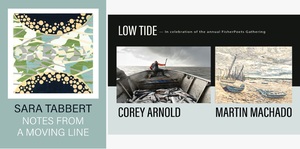
Low Tide
Corey Arnold & Martin Machado
February 14 – March 9
Opening Saturday, February 14th, 5 – 8 pm in connection with Astoria Artwalk is a new collection of photographs and paintings by Corey Arnold and Martin Machado. They bring Low Tide; an exhibition held in conjunction with the 2026 annual FisherPoets Gathering and in honor of the importance of the maritime industry and its history to our region. Once again, we bring together the work of photographer/commercial fisherman, Corey Arnold of White Salmon, Washington and painter/ fisherman/merchant marine, Martin Machado from San Francisco who share their love of the sea through chosen medium, merging their dual careers. Both artists are internationally respected having fished, sailed, and exhibited their work globally. Also included to this special exhibition held in conjunction with the annual Fisherpoets Gathering is Friends of Graveyard Point, a small collection of paintings and photographs by fellow fishing friends of Arnold and Machado.
In addition, opening Saturday, February 14th in our Front Gallery is a solo exhibition by Sara Tabbert of Fairbanks, Alaska. Known as a woodblock printmaker, her work has steadily evolved over the years into mixed media wall hung panels incorporating marquetry, a historic woodworking technique in which detailed design is applied to surface with wood veneer. Tabbert also includes relief carved and painted wood panels to her exhibition. This series, titled Notes from a Moving Line, is specifically about her observations from daily walks along the creek Big Eldorado that runs through the land where she lives. Sara will be at the gallery 5 – 8 pm, Saturday, February 14th and available to answer questions about her work. Both exhibitions will be on view through March 9th.
Longtime friends Corey Arnold and Martin Machado have much in common. Besides enjoying success as artists, both share a love of the sea and have cultivated careers that balance and inspire them professionally through maintaining constant connection to the world’s oceans. Arnold who’s chosen medium is photography brings a collection of images from his many years spent working as a commercial fisherman, always with his camera close by. Machado who has worked both as a merchant mariner and fisherman is a painter and printmaker and includes his paintings to this exhibition, specifically paintings inspired by his colleagues. Both artists bring intimate portraits of fellow fishermen for this exhibition, along with paintings and photographs inspired by time spent fishing Bristol Bay at Graveyard Point, Alaska.
Corey Arnold began fishing as a child, about the same time he first picked up a camera. What began as a weekend family adventure quickly became a permanent part of life. Arnold began fishing commercially in 1995 as a deckhand aboard various vessels and skiffs in Alaska. His career as a fine art photographer and fisherman has taken him far, both documenting and fishing the world’s oceans. Despite his international success as a photographer, Arnold returns every summer to Bristol Bay where he captains a skiff, fishing for salmon.
Arnold’s work is without doubt a celebration of the lifestyle of the fisherman. Through his lens he captures the raw and rugged reality of hard work, with brutal and honest images that depict both danger and beauty, sometimes in the same moment. About this series he states: “Low Tide is a photographic exploration of life at sea in Alaska, and the community, camaraderie, and moments of grace one experiences as a seasonal harvester of seafood.” Arnold has worked seasonally as a commercial fisherman for 30 years and now runs a set gillnet operation out of an abandoned cannery at Graveyard Point, photographing while he works and sometimes joining friends in other fisheries. This series is about those experiences and the people he works with.
Arnold, who graduated from the University of Art Academy in San Francisco has enjoyed a diverse and exciting career. His series Fish-Work was launched after receiving a commission from the PEW Charitable Foundation, taking him to Europe, and photographing from aboard fishing vessels in eight European countries. He has also been awarded an American Scandinavian Foundation grant which led to the documentation of the work of fishermen in Northern Norway. His work has been exhibited in Portland, San Francisco, Los Angeles, Chicago, and New York as well as numerous other venues worldwide, and published in Harpers, The New Yorker, New York Times LENS, Art Ltd, Rolling Stone, Time, Outside, National Geographic, Mare, and The Paris Review, among others. He is a recipient of a Hallie Ford Foundation Fellowship, a National Geographic Explorer Storytelling Grant, and the first-place award winner for the nature category of the World Press Review’s annual photography competition. Arnold has published two books of photography by Nazraeli Press including Fish-Work: The Bering Sea, and Fishing with My Dad. He is represented by Charles A. Hartman Fine Art in Portland, Oregon.
Martin Machado earned his MFA from the San Francisco Art Institute and like Arnold has always held a lifelong love of the sea. He too has cultivated multiple careers that merge, one providing inspiration to fuel the other. Machado brings a series of paintings that, like Arnold’s work, provide a window into a world most of us will never experience. His work directly reflects his time spent at sea as a merchant marine, a commercial fisherman and sailor. Working wherever he could cultivate space, sometimes within his cabin aboard a freighter, the cockpit of a sailboat, and even between net sets in Alaska. About his work he states: “My art works of course are not just about these two experiences, though they are often the jumping off points, they are often not even about the sea. My work is just as much about the forgetting of an experience, the blurring of time and place that happens within our memory. On this planet we are all seafarers of sorts, navigating our way through our modern lives. In my work I aim to celebrate the human spirit, especially among working class communities, and evoke a sense of awe and respect for our natural world.”
For this exhibition Machado brings paintings from his “Wake Series” oil paintings that as the series title suggests, focus on the abstracted element of churning or upwelling of water, the quickly erased footprint of a ship as it cuts through current. Besides the “Wake Series” Machado brings several smaller scale paintings portraying a closer look at life at sea from different personal perspectives, including paintings of mariners he has worked alongside. Specific to this series he states: “I wanted to try to focus on small portraits of the fishing folks that make up this community. I wish I had more time to paint them all, every single one is a character. The people that make up this community are vivacious and fiercely independent and replenish my soul on an annual basis. I like to think about this slice of existence that I’m witnessing in this place I’ve grown to know so well, and all the generations that came before to meet the salmon each summer. There is such a powerful energy to this salmon run, and I believe a lot of that strength is transferred to the people who fish there, both in sustenance and in spirit.”
Machado’s work has been featured in The San Francisco Chronicle, The New York Times Magazine, Juxapoz, New American Paintings, and The Surfer’s Journal. His work has been exhibited stateside from Seattle to New York, and internationally Chili, Malaysia, Scotland, and Mexico. His work was also included to a group exhibition at the prestigious deYoung Museum, San Francisco, CA.
Martin Machado and Corey Arnold have fished in the same set net community in Bristol Bay each summer for nearly two decades, “sharing the incredible highs and lows that come with fishing the most powerful natural fish run on earth from ridiculously tiny skiffs.” For their third exhibition together at Imogen, Arnold and Machado have invited a select group of fellow Graveyard fishing folks with artistic skills of their own to hang some of their works. This collection is by: Billie Delaney, Wesley Smith, Alex Wakeman, Stephen Amato, Gabbie Caspar, Derrick Fore, and Craig Voligny.
Imogen also presents a long-awaited third exhibition for Sara Tabbert from Fairbanks, Alaska. Tabbert, highly respected for her printmaking, brings a new series of both relief carved wood panels as well as wood panels incorporating marquetry. This series, Notes from a Moving Line considers landscape and Tabbert’s own observations of the landscape she lives within. About this series she states: “These pieces were generated from my daily walking route along a creek that runs through the land where I live. A walk in the morning is often a completely different experience than one in the evening. This landscape is always in flux. The creek’s surface changes in color all the time — bright white, sunset pink, acid green and yellow, a deep red-orange, and muddy browns that reflect the sky and surrounding landscape. There is sound and motion of breakup and runoff, and the slow settling and stilling of freeze-up, the almost incomprehensible surge of mosquitoes in mid-summer. From a distance, it’s a small, unremarkable, possibly unappealing landscape. On closer view and with attention, it is a wonderland.”
The focus of this exhibition will be Tabbert’s cedar relief wood panels that are carved and painted. Pattern, color and texture all come together to create elegant depictions of flora and fauna. Tabbert began creating the carved panels years ago as further exploration of her printmaking process and her shifting focus to woodworking techniques. Tabbert’s finished work is indicative of a union between exacting technical skill and an endless creative vision. In every piece the viewer can enjoy the outcome of what is created from strong intuitive knowledge and carefully, calculated fine craft.
Tabbert earned her Master of Fine Arts in printmaking from the University of Nebraska and has exhibited her work extensively throughout the United States and internationally. Her work can be found in permanent public collections, including the Anchorage Museum, Denali National Park & Preserve and Oregon State University’s prestigious Art About Agriculture collection. Tabbert has also enjoyed participating in artist residencies at Denali National Park, Zion National Park, Proyecto ACE in Buenos Aires, Argentina and at the Santa Reparata School of Art in Florence, Italy.
Low Tide
Corey Arnold & Martin Machado
February 14 – March 9
Opening Saturday, February 14th, 5 – 8 pm in connection with Astoria Artwalk is a new collection of photographs and paintings by Corey Arnold and Martin Machado. They bring Low Tide; an exhibition held in conjunction with the 2026 annual FisherPoets Gathering and in honor of the importance of the maritime industry and its history to our region. Once again, we bring together the work of photographer/commercial fisherman, Corey Arnold of White Salmon, Washington and painter/ fisherman/merchant marine, Martin Machado from San Francisco who share their love of the sea through chosen medium, merging their dual careers. Both artists are internationally respected having fished, sailed, and exhibited their work globally. Also included to this special exhibition held in conjunction with the annual Fisherpoets Gathering is Friends of Graveyard Point, a small collection of paintings and photographs by fellow fishing friends of Arnold and Machado.
In addition, opening Saturday, February 14th in our Front Gallery is a solo exhibition by Sara Tabbert of Fairbanks, Alaska. Known as a woodblock printmaker, her work has steadily evolved over the years into mixed media wall hung panels incorporating marquetry, a historic woodworking technique in which detailed design is applied to surface with wood veneer. Tabbert also includes relief carved and painted wood panels to her exhibition. This series, titled Notes from a Moving Line, is specifically about her observations from daily walks along the creek Big Eldorado that runs through the land where she lives. Sara will be at the gallery 5 – 8 pm, Saturday, February 14th and available to answer questions about her work. Both exhibitions will be on view through March 9th.
Longtime friends Corey Arnold and Martin Machado have much in common. Besides enjoying success as artists, both share a love of the sea and have cultivated careers that balance and inspire them professionally through maintaining constant connection to the world’s oceans. Arnold who’s chosen medium is photography brings a collection of images from his many years spent working as a commercial fisherman, always with his camera close by. Machado who has worked both as a merchant mariner and fisherman is a painter and printmaker and includes his paintings to this exhibition, specifically paintings inspired by his colleagues. Both artists bring intimate portraits of fellow fishermen for this exhibition, along with paintings and photographs inspired by time spent fishing Bristol Bay at Graveyard Point, Alaska.
Corey Arnold began fishing as a child, about the same time he first picked up a camera. What began as a weekend family adventure quickly became a permanent part of life. Arnold began fishing commercially in 1995 as a deckhand aboard various vessels and skiffs in Alaska. His career as a fine art photographer and fisherman has taken him far, both documenting and fishing the world’s oceans. Despite his international success as a photographer, Arnold returns every summer to Bristol Bay where he captains a skiff, fishing for salmon.
Arnold’s work is without doubt a celebration of the lifestyle of the fisherman. Through his lens he captures the raw and rugged reality of hard work, with brutal and honest images that depict both danger and beauty, sometimes in the same moment. About this series he states: “Low Tide is a photographic exploration of life at sea in Alaska, and the community, camaraderie, and moments of grace one experiences as a seasonal harvester of seafood.” Arnold has worked seasonally as a commercial fisherman for 30 years and now runs a set gillnet operation out of an abandoned cannery at Graveyard Point, photographing while he works and sometimes joining friends in other fisheries. This series is about those experiences and the people he works with.
Arnold, who graduated from the University of Art Academy in San Francisco has enjoyed a diverse and exciting career. His series Fish-Work was launched after receiving a commission from the PEW Charitable Foundation, taking him to Europe, and photographing from aboard fishing vessels in eight European countries. He has also been awarded an American Scandinavian Foundation grant which led to the documentation of the work of fishermen in Northern Norway. His work has been exhibited in Portland, San Francisco, Los Angeles, Chicago, and New York as well as numerous other venues worldwide, and published in Harpers, The New Yorker, New York Times LENS, Art Ltd, Rolling Stone, Time, Outside, National Geographic, Mare, and The Paris Review, among others. He is a recipient of a Hallie Ford Foundation Fellowship, a National Geographic Explorer Storytelling Grant, and the first-place award winner for the nature category of the World Press Review’s annual photography competition. Arnold has published two books of photography by Nazraeli Press including Fish-Work: The Bering Sea, and Fishing with My Dad. He is represented by Charles A. Hartman Fine Art in Portland, Oregon.
Martin Machado earned his MFA from the San Francisco Art Institute and like Arnold has always held a lifelong love of the sea. He too has cultivated multiple careers that merge, one providing inspiration to fuel the other. Machado brings a series of paintings that, like Arnold’s work, provide a window into a world most of us will never experience. His work directly reflects his time spent at sea as a merchant marine, a commercial fisherman and sailor. Working wherever he could cultivate space, sometimes within his cabin aboard a freighter, the cockpit of a sailboat, and even between net sets in Alaska. About his work he states: “My art works of course are not just about these two experiences, though they are often the jumping off points, they are often not even about the sea. My work is just as much about the forgetting of an experience, the blurring of time and place that happens within our memory. On this planet we are all seafarers of sorts, navigating our way through our modern lives. In my work I aim to celebrate the human spirit, especially among working class communities, and evoke a sense of awe and respect for our natural world.”
For this exhibition Machado brings paintings from his “Wake Series” oil paintings that as the series title suggests, focus on the abstracted element of churning or upwelling of water, the quickly erased footprint of a ship as it cuts through current. Besides the “Wake Series” Machado brings several smaller scale paintings portraying a closer look at life at sea from different personal perspectives, including paintings of mariners he has worked alongside. Specific to this series he states: “I wanted to try to focus on small portraits of the fishing folks that make up this community. I wish I had more time to paint them all, every single one is a character. The people that make up this community are vivacious and fiercely independent and replenish my soul on an annual basis. I like to think about this slice of existence that I’m witnessing in this place I’ve grown to know so well, and all the generations that came before to meet the salmon each summer. There is such a powerful energy to this salmon run, and I believe a lot of that strength is transferred to the people who fish there, both in sustenance and in spirit.”
Machado’s work has been featured in The San Francisco Chronicle, The New York Times Magazine, Juxapoz, New American Paintings, and The Surfer’s Journal. His work has been exhibited stateside from Seattle to New York, and internationally Chili, Malaysia, Scotland, and Mexico. His work was also included to a group exhibition at the prestigious deYoung Museum, San Francisco, CA.
Martin Machado and Corey Arnold have fished in the same set net community in Bristol Bay each summer for nearly two decades, “sharing the incredible highs and lows that come with fishing the most powerful natural fish run on earth from ridiculously tiny skiffs.” For their third exhibition together at Imogen, Arnold and Machado have invited a select group of fellow Graveyard fishing folks with artistic skills of their own to hang some of their works. This collection is by: Billie Delaney, Wesley Smith, Alex Wakeman, Stephen Amato, Gabbie Caspar, Derrick Fore, and Craig Voligny.
Imogen also presents a long-awaited third exhibition for Sara Tabbert from Fairbanks, Alaska. Tabbert, highly respected for her printmaking, brings a new series of both relief carved wood panels as well as wood panels incorporating marquetry. This series, Notes from a Moving Line considers landscape and Tabbert’s own observations of the landscape she lives within. About this series she states: “These pieces were generated from my daily walking route along a creek that runs through the land where I live. A walk in the morning is often a completely different experience than one in the evening. This landscape is always in flux. The creek’s surface changes in color all the time — bright white, sunset pink, acid green and yellow, a deep red-orange, and muddy browns that reflect the sky and surrounding landscape. There is sound and motion of breakup and runoff, and the slow settling and stilling of freeze-up, the almost incomprehensible surge of mosquitoes in mid-summer. From a distance, it’s a small, unremarkable, possibly unappealing landscape. On closer view and with attention, it is a wonderland.”
The focus of this exhibition will be Tabbert’s cedar relief wood panels that are carved and painted. Pattern, color and texture all come together to create elegant depictions of flora and fauna. Tabbert began creating the carved panels years ago as further exploration of her printmaking process and her shifting focus to woodworking techniques. Tabbert’s finished work is indicative of a union between exacting technical skill and an endless creative vision. In every piece the viewer can enjoy the outcome of what is created from strong intuitive knowledge and carefully, calculated fine craft.
Tabbert earned her Master of Fine Arts in printmaking from the University of Nebraska and has exhibited her work extensively throughout the United States and internationally. Her work can be found in permanent public collections, including the Anchorage Museum, Denali National Park & Preserve and Oregon State University’s prestigious Art About Agriculture collection. Tabbert has also enjoyed participating in artist residencies at Denali National Park, Zion National Park, Proyecto ACE in Buenos Aires, Argentina and at the Santa Reparata School of Art in Florence, Italy.
January 2026 Exhibit

Nicholas Knapton
Surfing with a Lifejacket
We are excited to welcome back Nicholas Knapton, a Pacific Northwest artist who has been balancing his career between Astoria, Oregon and Berlin, Germany for nearly three decades. For this series, Surfing with a Lifejacket, Nicholas brings paintings and drawings for his solo exhibition that takes on a more personal note. The show opens during Astoria’s Artwalk, Saturday, January 10 and Nicholas will be at the gallery that evening from 5 – 8 pm, come say hello and learn more about him and his diverse career. The exhibition will be on view through February 9.
Knapton, born in York, England and raised in Astoria, has a fascinating story. His sense of connection to home has always been strong, regardless of how far away he found himself and with the ever-present need to immerse himself in other cultures, studying other languages and always gathering knowledge from wherever he landed to then imbue into his artwork. Back now, full time in his Astoria studio he has settled and with that comes looking inward, considering personal issues as well as the world at large. He takes a keen look at life’s struggles, whether it be on a global level or internal to himself and how those can relate.
Knapton continues with his recognizable direct and edgy abstract style, however within this series he brings brighter color to his palette. Gone is the moody darkness inspired by old gritty Astoria and war-torn East Berlin, instead turning to a more playful upbeat pallet, perhaps reflecting a hopeful future that we all look towards. His style still contains reference to the avant garde German Expressionist movement, an inescapable influence from his years living in Berlin within the rebellious counterculture, after the Wall came down and the unification of the country.
About this series he states: “The work is about perspective—of the figure, on myself, on paper, on canvas. Ten small drawings wrestle with seizures: containment, interruption, collapse, repair. The large canvases take on the figure at scale, where the body becomes both subject and opponent. My neurologist told me that if I were to surf, I’d have to surf with a life jacket. The image is absurd, impossible, necessary. Protection and suffocation at once. That tension runs through everything: the body versus the idea, ego versus shame, resistance versus surrender.
What remains is persistence. A refusal to stop dragging the figure, and myself, back into the frame—again and again—until movement itself becomes the subject.”
Knapton, who began his art studies at Clatsop Community College under the tutelage of Royal Nebeker and Richard Rowland has balanced a career that has taken him back and forth between two very distinctive art communities, exhibiting his work here in Astoria, Portland to the other side of the Atlantic in Berlin, Paris, Estonia, and other European art houses. This dual career is what inspires him, allowing him to participate in an epicenter to creative thought while also bringing it home to a quieter village lifestyle. It is living here, in a more rural setting, that gives him space to contemplate his broader experiences, shaping and defining his focus. His experience in both communities translates to a bold painterly style where both dynamic layers of energy and spontaneity find spaces of open calm and dynamic use of color.
Knapton’s flexibility in lifestyle has allowed him experiences few will encounter. After finishing studies at Clatsop Community College, he headed to Portland where he attended Portland State University, studying under Northwest notables such as Mel Katz, Linda Wysong and Susan Harlan. With a strong core of knowledge, Knapton then jumped into the then burgeoning Berlin art scene. While in Europe he assisted with the restorations of the Royal Opera House at Covent Garden, London, and participated in the Wrapped-Reichstag project by famed installation artists Christo and Jeanne Claude in Berlin. Back home, his figurative work has been juried into the annual Au Naturel International Juried Exhibition multiple times by acclaimed art professionals, including an awarded purchase prize from the college. He continues to exhibit his work both in the Northwest as well as Berlin.
Nicholas Knapton
Surfing with a Lifejacket
We are excited to welcome back Nicholas Knapton, a Pacific Northwest artist who has been balancing his career between Astoria, Oregon and Berlin, Germany for nearly three decades. For this series, Surfing with a Lifejacket, Nicholas brings paintings and drawings for his solo exhibition that takes on a more personal note. The show opens during Astoria’s Artwalk, Saturday, January 10 and Nicholas will be at the gallery that evening from 5 – 8 pm, come say hello and learn more about him and his diverse career. The exhibition will be on view through February 9.
Knapton, born in York, England and raised in Astoria, has a fascinating story. His sense of connection to home has always been strong, regardless of how far away he found himself and with the ever-present need to immerse himself in other cultures, studying other languages and always gathering knowledge from wherever he landed to then imbue into his artwork. Back now, full time in his Astoria studio he has settled and with that comes looking inward, considering personal issues as well as the world at large. He takes a keen look at life’s struggles, whether it be on a global level or internal to himself and how those can relate.
Knapton continues with his recognizable direct and edgy abstract style, however within this series he brings brighter color to his palette. Gone is the moody darkness inspired by old gritty Astoria and war-torn East Berlin, instead turning to a more playful upbeat pallet, perhaps reflecting a hopeful future that we all look towards. His style still contains reference to the avant garde German Expressionist movement, an inescapable influence from his years living in Berlin within the rebellious counterculture, after the Wall came down and the unification of the country.
About this series he states: “The work is about perspective—of the figure, on myself, on paper, on canvas. Ten small drawings wrestle with seizures: containment, interruption, collapse, repair. The large canvases take on the figure at scale, where the body becomes both subject and opponent. My neurologist told me that if I were to surf, I’d have to surf with a life jacket. The image is absurd, impossible, necessary. Protection and suffocation at once. That tension runs through everything: the body versus the idea, ego versus shame, resistance versus surrender.
What remains is persistence. A refusal to stop dragging the figure, and myself, back into the frame—again and again—until movement itself becomes the subject.”
Knapton, who began his art studies at Clatsop Community College under the tutelage of Royal Nebeker and Richard Rowland has balanced a career that has taken him back and forth between two very distinctive art communities, exhibiting his work here in Astoria, Portland to the other side of the Atlantic in Berlin, Paris, Estonia, and other European art houses. This dual career is what inspires him, allowing him to participate in an epicenter to creative thought while also bringing it home to a quieter village lifestyle. It is living here, in a more rural setting, that gives him space to contemplate his broader experiences, shaping and defining his focus. His experience in both communities translates to a bold painterly style where both dynamic layers of energy and spontaneity find spaces of open calm and dynamic use of color.
Knapton’s flexibility in lifestyle has allowed him experiences few will encounter. After finishing studies at Clatsop Community College, he headed to Portland where he attended Portland State University, studying under Northwest notables such as Mel Katz, Linda Wysong and Susan Harlan. With a strong core of knowledge, Knapton then jumped into the then burgeoning Berlin art scene. While in Europe he assisted with the restorations of the Royal Opera House at Covent Garden, London, and participated in the Wrapped-Reichstag project by famed installation artists Christo and Jeanne Claude in Berlin. Back home, his figurative work has been juried into the annual Au Naturel International Juried Exhibition multiple times by acclaimed art professionals, including an awarded purchase prize from the college. He continues to exhibit his work both in the Northwest as well as Berlin.


